Sequence page
The sequence page shows the runs, including ace-two-three, without turning the count into a betting system.
Read the note22100 is the classic total. Teen patti probability on this page is that no-joker count, and each holding is three cards from a 52-card deck. The six hand types below share those 22100. Jokers change the math. Nothing here promises the next deal.
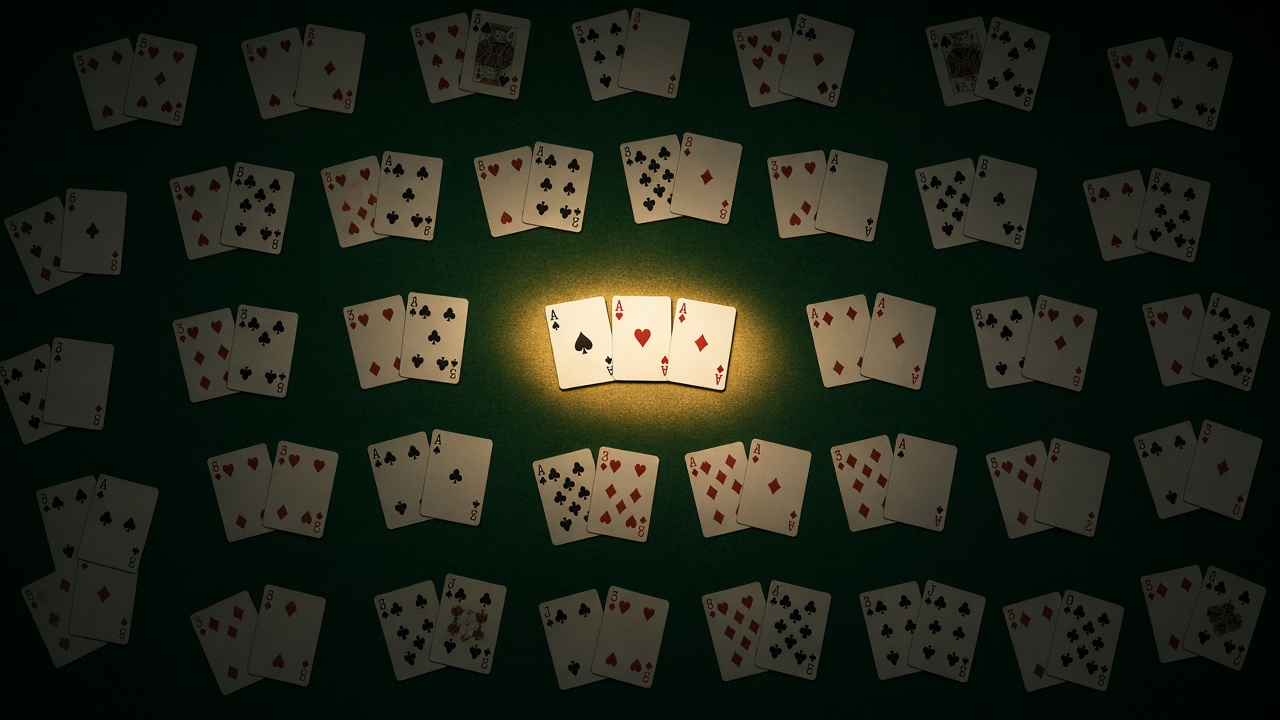
Count it as C(52,3). Take 52 ranks and suits, choose 3, and the arithmetic is 22100. These are no-joker combinations of that figure. A wild rank, a stripped deck, or a five-card cousin is a different sum. Do not paste these numerators onto a tile that says joker.
People ask for teen patti odds and mean this table. The probability of teen patti hands here is the classic set only. If your room prints a different help card, the help card wins. This is an independent guide, not the publisher and not a casino. It cannot return a stake.
About 0.24 percent does not mean "due soon." It means that if you dealt every possible three from a fair deck once, a trail would appear 52 times. Your next sitting will not cycle through all 22100. You might see two trails. You might see none. Teen patti probability is a map of the deck, not a clock on your session.
Memorise the order of the ladder beside the rates. Trail beats pure sequence. Pure sequence beats a mixed sequence. A mixed sequence beats colour. Colour beats a pair. A pair beats high card. The rare hands sit at the top. The common hand is the one you will actually hold: nothing matched.
Suits do not rank against each other in a classic tie. Two king-queen-jack holdings in mixed suits are the same rank. A house rule may split the pot or apply a posted tie break. The counts below do not invent a suit order to force a winner.
Three queens is a trail. Three deuces is a trail. Three aces is the best of them. The trail probability is 52 holdings out of 22100, about 0.24 percent. That is the whole classic numerator. Do not round it to 50 to make the story cleaner, and do not treat a pair of aces as "almost" this hand.
Teen patti probability puts the trail first because the ladder does, not because you should wait all night for one. If you play every king-high on the theory that a trail is "around the corner," you will pay for a corner that usually is not there. Fold the rag. Let the rare hand arrive when it arrives.
Ace, king, queen of hearts is a pure sequence. So is ace, two, three of spades, the run where the ace sits low. Four, five, six of diamonds is the same family. Teen patti probability counts 48 pure sequences, about 0.22 percent. Slightly thinner than a trail. Still a hand you will brag about, because you will not see it often.
Drop the suit requirement and the run becomes an impure sequence. King of spades, queen of hearts, jack of clubs. Same ranks, mixed suits. It loses to any pure sequence and beats colour. Teen patti probability counts 720 of these, about 3.3 percent. You will meet this hand. You will not meet it every orbit.
Sequence probability on this page keeps those two numerators apart: 48 pure, 720 impure. Adding them hides the suit requirement, and the suit requirement is the difference between second place and third. The sequence page shows the runs, including ace-two-three, without turning the count into a betting system.
King, nine, and four of hearts is colour. Same suit, not in a row. It feels loud. Under this ladder it loses to any sequence, pure or mixed. Teen patti probability counts 1096 colour holdings, about 5.0 percent. More common than a run, less common than a pair. If you learned poker first, pause here. A flush does not outrank a straight in this game.
That reversal is why a pretty suit loses pots. You see three hearts and your hand wants to raise. The other player shows a mixed king-queen-jack and takes the middle. The count explains the bruise. Colour is not rare enough to treat as a miracle, and it is not strong enough to ignore a run.
A pair of nines with a four beside them is a pair. The spare breaks a tie between equal pairs: nines with a king beat nines with a six. Teen patti probability counts 3744 pairs, about 16.9 percent. Roughly one holding in six. Common enough to respect, common enough that a small pair should not start a war when several players are still to act.
Everything else is high card. King, ten, four, unmatched, not a suit. Teen patti probability counts 16440 of them, about 74.4 percent. About three deals in four, if the deck is classic and fair, you hold nothing that matches. A bare king is the normal object on the felt. Playing it like a pair is how the boot walks away.
Add the six numerators. 52 plus 48 is 100. Plus 720 is 820. Plus 1096 is 1916. Plus 3744 is 5660. Plus 16440 is 22100. The teen patti probability check is that last sum. If a chart's pieces do not add back to C(52,3), the chart has edited a numerator. These have not.
Introduce one wild rank and the 22100 stops being the right universe. Some holdings that were high card become pairs or better. Some runs appear that the classic deck could not make from those three ranks. A joker teen patti probability is a fresh count, and this page will not invent one. Play the posted wild rules, or leave the tile. Do not "adjust" 52 and 48 in your head and call it close enough.
AK47, 999, and lowest-joker rooms are the same warning with different names. The felt looks familiar. The numerator is not. House text wins when it disagrees with a general table.
Deal a physical deck if you want the shape in your hands. Shuffle, take three, name the category, and put them back. After twenty deals you will have met mostly unmatched ranks, a few pairs, and maybe one colour. You will probably not have met a trail. That evening is not a broken deck. It is 16440 versus 52 doing what the arithmetic said. If a pure run shows up, enjoy it and still check the price before you raise. Rarity is not a command to empty the stack.
Phone tables shuffle faster than your hands will. The speed does not change the classic numerators, and it does not give you a peek at anyone else's three. Use the rates to stay humble about a pair of sixes. Leave the rates alone when you are angry, because anger reads "about 0.24 percent" as "soon" and soon is not a rank.
Keep a classic teen patti probability note for those six numerators only, then let the price on the button decide whether you call or fold.
A prior is useful when you decide whether a raise is a story. You hold colour. You know a sequence is less common than colour, and a trail is rare. You still do not know what the player on your right was dealt. Teen patti probability does not see their three. It only tells you how the deck was built. The call in front of you is a price, and the price can be wrong even when your category is pretty.
Treat a thin rate as a reason to stay calm, not as a reason to chase until the rare hand appears. Chasing a trail because "it is due" ignores the shuffle. Each deal is a new draw from the same 22100, not a queue that owes you the missing category.
The ladder with one example of each hand lives on the hand rankings page. Which holding sits at the very top, and how ties behave, is on the strongest hand page. Read those before you argue a show. Bring this count when you want the classic frequencies, and leave it in the drawer when the tile says wild.
No. They are no-joker holdings from C(52,3), which equals 22100. A wild rank changes the math.
Because any run beats any same-suit holding that is not a run. The count is larger for colour than for an impure sequence, and the ladder still ranks the run higher.
In the classic no-joker count, yes. 16440 out of 22100 is about 74.4 percent. A bare king is ordinary.
No. Frequencies describe the deck. They do not control the next shuffle or the price someone else is willing to call.
Write them down if you need to: trail 52, pure sequence 48, impure sequence 720, colour 1096, pair 3744, high card 16440. That is teen patti probability for a fair 52-card deck with nothing wild. Play the boot you can lose. Let the rare hands be rare.
Teen patti odds are those six numerators over 22,100. The probability of teen patti hands changes the moment a helper enters the deck.
18+ where the table is real-cash. Rates are not a promise of profit. This guide does not run the game.
The sequence page shows the runs, including ace-two-three, without turning the count into a betting system.
Read the noteThe ladder with one example of each hand lives on the hand rankings page.
Read the note